


 Thruline
Centralized context for teamwide AI integration
Agents vary. Your conventions don't. Thruline aligns every agent with the real source of truth: your code.
Thruline discovers your team's conventions and makes it easy to see how everything connects across every repo in your org.
Thruline is built for devs, leads, maintainers, and any reviewer drowning in agent-generated PRs.
It's your new single source of truth for how your team builds, learned from your code and its history.
The code works. It's still not yours.
LLMs re-derive your architecture from scratch every session, so different agents handle the same requirement in incompatible ways.
The output passes tests and clears CI while quietly violating how your team actually builds, adding to the drift until the drift becomes the architecture.
Agents ignore your conventions
They infer patterns from a handful of files and miss the ones your team settled on deliberately, so working code still isn't your code.
The review burden compounds
More PRs are coming, and faster. Reviewers burn their days catching the same convention drift instead of focusing on design requirements.
Senior knowledge erodes
The why behind your architecture lives in a few heads. Agents can't reach it, and every ungoverned change dilutes it.
Centralized context surfaced automatically.
Thruline extracts your team's explicit and inherent coding conventions automatically, then structures them into queryable standards that influence agents' decisions as they work.
Index the default branch of your repos
Thruline discovers your repos' domains, the conventions governing each area, and how everything connects across every repo in your org.
Review and approve your standards
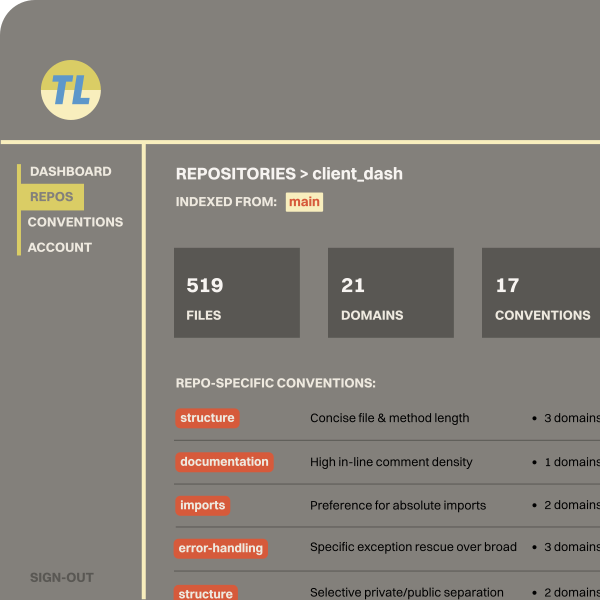
Thruline lists all your team's conventions in a clean dashboard so you can upvote, downvote, dismiss, or lock them in as official standards.
Spin up agents and ship their code confidently
Your team's conventions, now standardized and easily accessible, direct agents' work so the code they produce fits your team.
Context made available to all your editors, agents, and workflows.
Thruline's MCP server plugs into any AI-powered editor, and the GitHub App reviews every pull request independently of editor choice. Your team keeps its tools, Thruline keeps them aligned.
No platform lock-in.





Structured & deterministic
Unlike RAG codebase-search tools, Thruline's retrieval is deterministic and its knowledge is structured. You can rely on convention retrieval and adherence in a way vibes-based similarity tools can't.
Comprehensive & consolidated
Thruline consolidates conventions across every repo in your org, expanding an agent's observable blast radius so you can catch cross-repo violations and enforce standards adherence at a team level.
Continuously improving
Review findings and outcomes feed back into your team index, so guidance sharpens over time. A rules file only changes when a human edits it and a RAG index only changes when the code does.
Aligned teams ship faster
Frequently Asked Questions
Is Thruline just another linter?
No. Linters enforce universal, pre-defined rules that are the same for every codebase. Thruline learns the conventions, architectural domains, and co-change patterns specific to your repository by analyzing your code and git history. The two serve different purposes and work well together.
Will Thruline slow down my workflow?
Thruline's intelligence is pre-computed. When you request context or a review, the knowledge is already structured and ready. There's no waiting for a full codebase scan. For GitHub PR reviews, analysis runs in parallel and results appear as inline annotations.
What editors does Thruline support?
Claude Code, Cursor, Windsurf, VS Code, Zed, and any other AI-powered editor. Thruline also integrates as a GitHub App for automated PR reviews that work independently of your editor choice.
How does Thruline handle privacy?
Thruline stores file metadata, AI-generated summaries, and architectural metrics — not your full source code. Clipped file contents are sent to our servers during indexing and analysis, processed through the Anthropic API, and discarded after summaries are generated. Only the summaries persist.
How long does setup take?
Point Thruline at your repository and the initial index runs in minutes. After that, only changed files are re-processed. Domain discovery and convention extraction happen automatically with no manual configuration.
Does Thruline work for monorepos?
Yes. Thruline identifies cohesive structural clusters within your dependency graph regardless of repository size or organization. Monorepos with multiple services, shared libraries, and feature modules are handled naturally.
What languages does Thruline support?
JavaScript, TypeScript, Python, Ruby, Go, and Java, with framework-specific intelligence for React, Next.js, Rails, Django, and more. Language and framework detection is automatic.